Back to briefing room
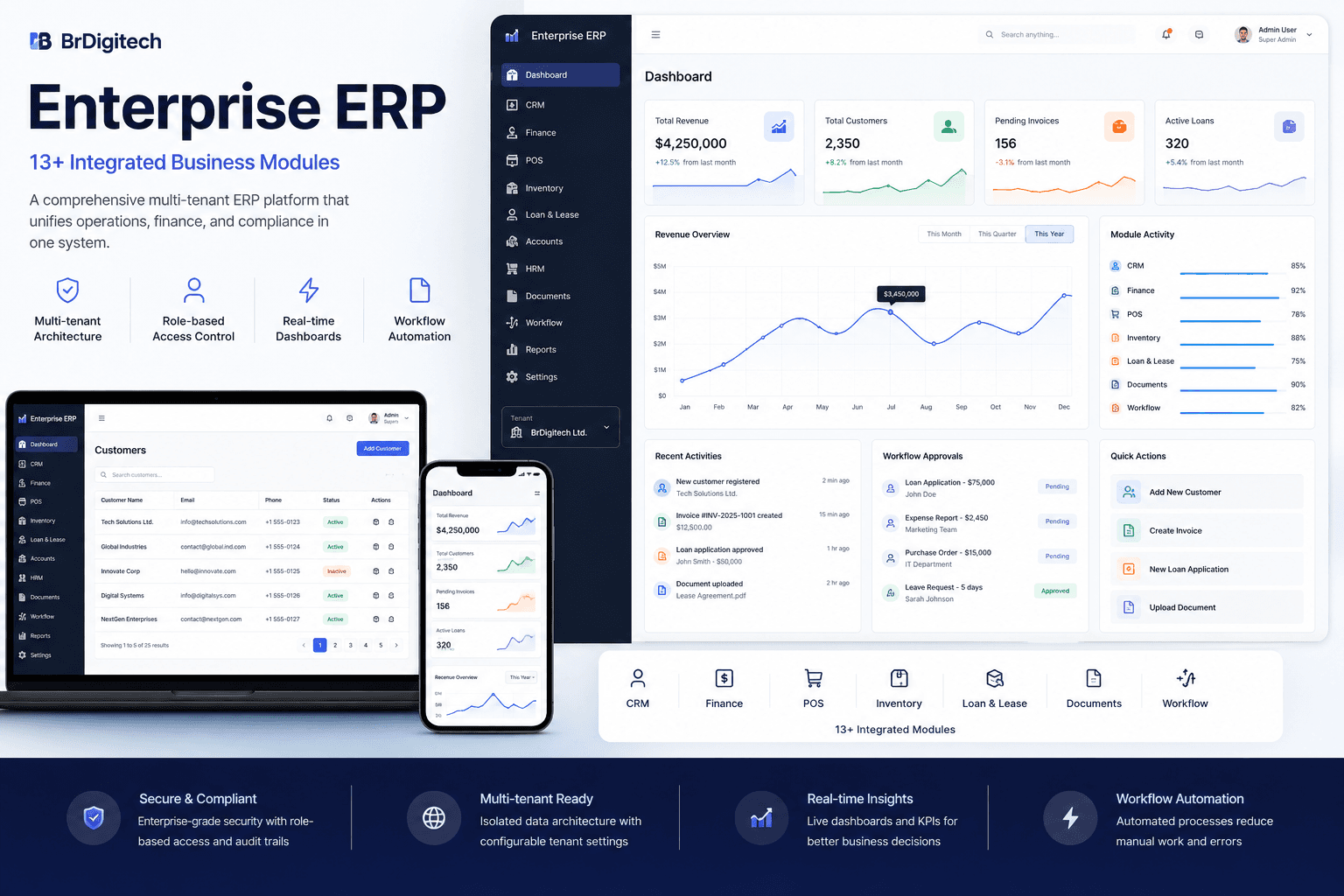
Enterprise ERP Platform
CS-001 · Field reportEnterprise

Enterprise ERP Platform

How modular architecture cut enterprise onboarding time by 40%.

40%

Faster onboarding

13+

Live modules

99.9%

Uptime

BrDigitechLead Full Stack EngineerOngoing · multi-phase rollout

Enterprise clients were stuck on bespoke deployments. We replaced one-off setups with a modular, multi-tenant ERP core — enabling faster go-lives, granular permissions, and real-time visibility without sacrificing tenant isolation.

Before → After

Weeks per client setup

Days with module packages

Siloed spreadsheets

Live multi-branch KPIs

Manual permission tickets

Self-serve RBAC admin

Context

BrDigitech serves enterprise accounts that need CRM, finance, POS, and document workflows in one product — not a patchwork of tools.

Each new client historically required weeks of custom wiring for modules, roles, and reporting.

The mandate: ship a platform that scales tenants while keeping branch-level control for franchise and multi-site operators.

The challenge

Legacy processes and disconnected modules created operational bottlenecks across 13+ business functions. Onboarding stretched timelines, support load grew, and leadership lacked a single real-time view across branches.

The response

Architected a unified multi-tenant ERP with modular service boundaries, dynamic RBAC, workflow automation, and Socket.IO dashboards — so new tenants inherit a proven foundation and only configure deltas.

How it unfolded

01

Situation

Multiple enterprise pilots demanded different module mixes, but engineering treated each as a greenfield fork.

02

Strategy

Defined domain modules (CRM, Finance, POS) behind shared auth, tenant middleware, and a reusable admin shell.

03

Execution

Rolled out modules incrementally with CI/CD on AWS, real-time KPI tiles, and admin-configurable RBAC.

04

Outcome

Onboarding dropped 40%, feature delivery accelerated 35%, and production uptime held at 99.9%.

Architecture decisions

MongoDB + MySQL split

Operational documents and flexible schemas in MongoDB; relational finance and reporting in MySQL for audit-friendly queries.

Module packages over forks

Tenants enable module bundles via configuration — engineering ships once, clients activate what they need.

Branch-level RBAC

Franchise models needed permissions scoped to branch and department without duplicate user records.

Implementation approach

  • Modular domain APIs behind shared authentication middleware
  • Event-driven notifications and Socket.IO live dashboards
  • Granular RBAC mapped to modules and actions
  • Reusable component library for admin surfaces
  • AWS CI/CD with environment-based tenant configuration

Measured results

  • 40% reduction in client onboarding time
  • 13+ production modules sharing one tenant core
  • 99.9% uptime across managed deployments
  • 35% faster feature delivery via shared UI primitives

Lessons learned

  1. 01Invest in tenant isolation at the data layer early — retrofitting is expensive.
  2. 02RBAC should be admin-configurable; engineering-only permission changes do not scale.
  3. 03Real-time dashboards increase adoption more than static exports for ops teams.

Technology

Next.jsNode.jsMongoDBMySQLTypeScriptSocket.IOAWS

Related build

View product dossier

Technical features, stack, and architecture notes

Next report · CS-002

QR Restaurant SaaS

QR-first ordering that reduced peak-hour processing time by 30%.

Work together

Need similar outcomes on your product?

Share your constraints and goals — I'll outline how we'd approach architecture and delivery.